COSTS AND FINOPS · AVAILABLE
Your FinOps journey. From goals to decisions.
Define your objectives, assess your maturity and organise your governance. Then connect costs, optimisations and decisions within one framework to turn ambition into action.
Interactive demo with sample data.
02 / FINOPS ADOPTION
Before managing costs, build your approach.
More than a dashboard: a framework to adopt, manage and improve your FinOps practice. The Adoption module connects your ambitions to measurable objectives, clear governance and an approved plan.
01
Set measurable objectives
Define your strategic objectives, associated KPIs, baselines and targets. Assign an owner and a deadline to each objective.
02
Assess your maturity and target state
Evaluate your practices with a questionnaire linked to your chosen objectives. Measure the gaps between your current maturity and target state, capability by capability.
03
Organise your governance
Assign roles to owners, formalise your RACI and define your committees: frequency, participants and expected decisions.
04
Approve a plan and keep improving
Turn gaps into actions, prepare your data sources and submit the roadmap to your sponsor. Set a baseline and schedule the next assessment.
03 / THE EIGHT FINOPS MODULES
Eight modules to put your approach into action.
Adoption sets the direction. The eight modules connect objectives, data, costs and decisions through to action tracking and realised value.
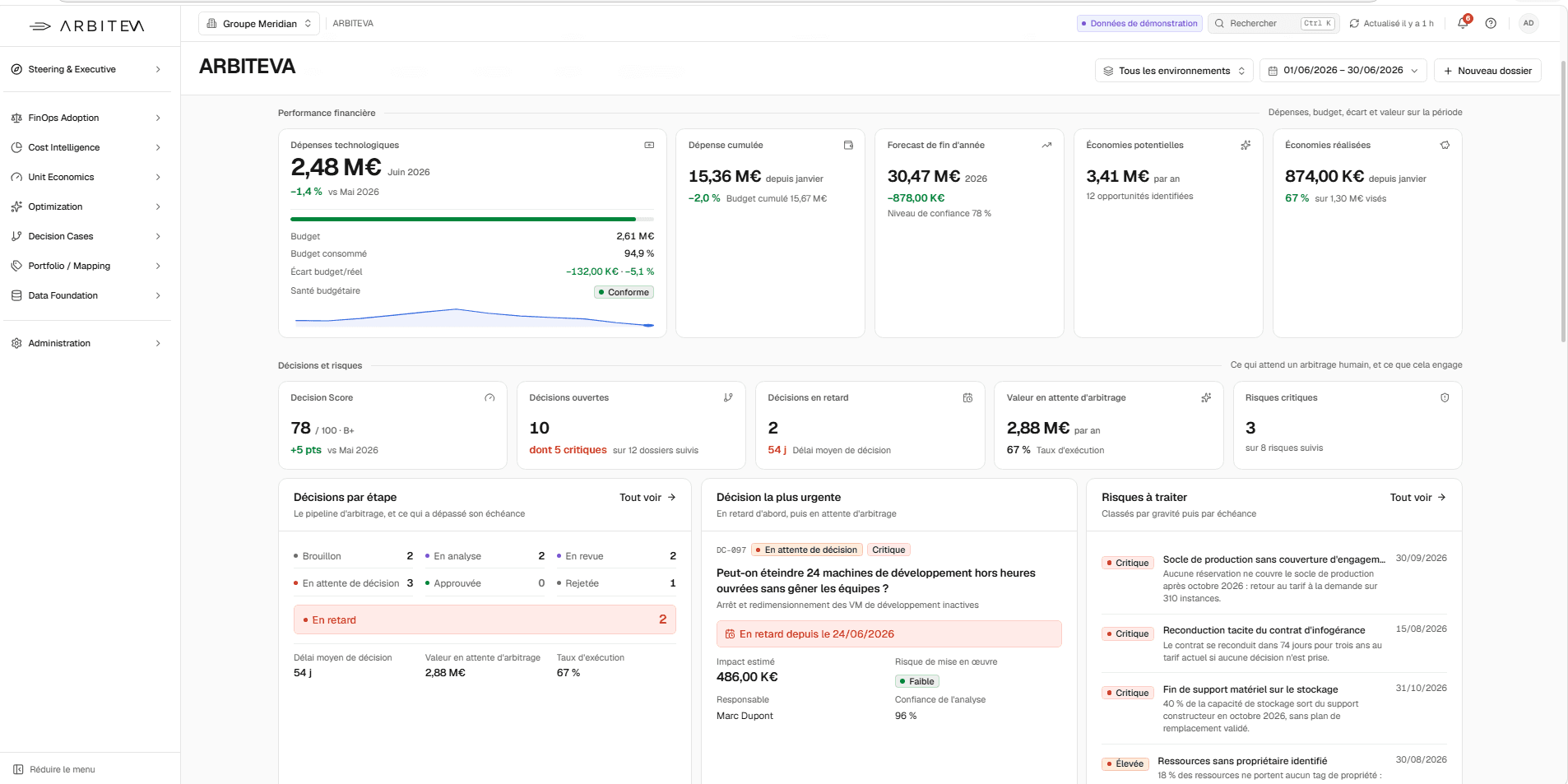
Steering & Executive
Cross-functional oversight: KPIs, budgets, forecasts and trade-offs.
FinOps Adoption
Objectives and KPIs, current and target maturity, governance and an approved adoption plan.
Cost Intelligence
Cost analysis by business unit, application, provider and technology.
Unit Economics
Unit costs and business value.
Optimization
Savings opportunities and optimisation tracking.
Decision Cases
Quantified scenarios, business cases and decisions.
Portfolio / Mapping
Mapping and relationships between applications, business units and resources.
Data Foundation
Sources, ingestion, normalisation and data quality.